Education and employability
While access to education has continued to improve across the Eastern Partnership region, findings from the 2025 ETF cross‑country monitoring report show that concerns about the quality and relevance of education persist. Despite near‑universal enrolment in compulsory schooling, many young people in Armenia, Georgia and Moldova leave basic education without the foundational skills needed for successful progression – with underachievement in mathematics reaching 55-66% in several EaP countries.
These systemic gaps are largely caused by limited institutional capacity, shortages of qualified teachers, and constrained resources – particularly in rural areas and in VET institutions where outdated equipment and uneven access to practical training hinder learning. As a result, the region continues to struggle to align education outcomes with labour‑market needs, contributing to skills mismatches and difficulties in young people’s transition from school to work. Youth unemployment therefore remains high, reflecting the persistent gap between the competencies delivered by education systems and those demanded by employers.
Acknowledging these challenges, the EU4Youth programme supported partner countries in building more effective structures to ease the transition from education to work and advanced the recognition of skills gained through non‑formal and informal learning. Throughout the reporting year, EU4Youth expanded competence‑development activities through its grant projects, provided additional training for youth educators, and created more opportunities for young people to gain practical experience through scholarships, mobility offers, and work‑based learning initiatives.
The majority of data for these initiatives was last fully reported in 2024. The information on this report provides a brief consolidated update for 2025.
Young people’s work preparedness
Young people across the Eastern Partnership have a strong capacity to contribute to innovation, economic development and broader societal progress. However, many graduates still face obstacles when seeking employment or trying to launch their own ventures. To help ease this transition into the labour market, the EU4Youth programme supports specialised training designed to strengthen young people’s practical skills and readiness for work. Throughout 2025, the programme rolled out a wide range of competence-building activities that equipped young people with skills relevant to the digital and green transitions, while also nurturing essential transversal and soft skills needed for today’s evolving job market.
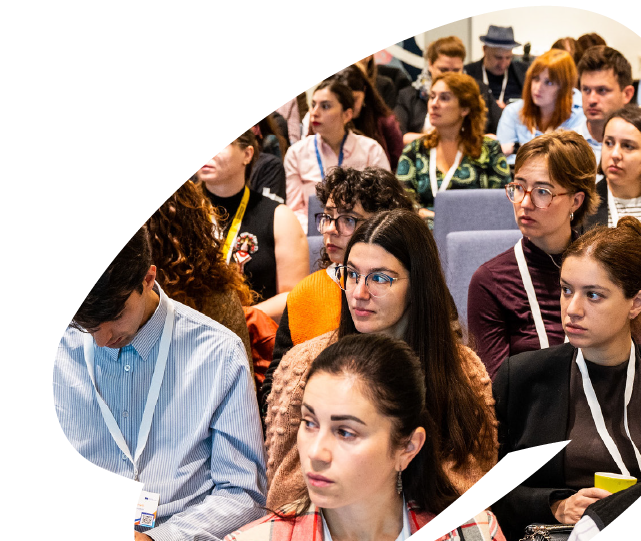 The regional grant projects supported through the EU4Youth: Youth Employment and Entrepreneurship initiative share a common goal of strengthening young people’s prospects in the labour market, with particular emphasis on green and digital skill development and the cultivation of entrepreneurial abilities.
In 2025, more than 1,050 competence development activities were delivered through the seven regional grants together with the five direct grants to Ukraine. Across the region, close to 3,000 young people took part in tailored skills building and extracurricular learning opportunities. Women represented over 47 per cent of all participants, while around 53 per cent were identified by the projects as disadvantaged youth.
The SEEDS project - Social Entrepreneurship and Enhanced Development based Skills in Georgia and Ukraine, implemented by the Danish Refugee Council (DRC) and funded by the European Union, continues to strengthen innovative skills development for young people through initiatives such as Youth Career Development Clubs in Georgian schools. These clubs provide career planning training, psychological support, expert engagement, enterprise study visits, and adapted digital learning resources, empowering vulnerable youth with practical knowledge and skills to plan their professional future.
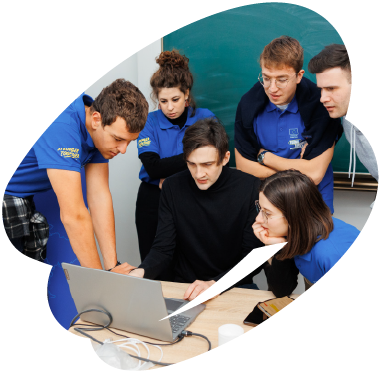 In 2025, the SEEDS project continued strengthening entrepreneurial skills among young people in Georgia and Ukraine, with 93 young people participating in competence development activities focused on entrepreneurship, delivered through both face-to-face and online formats.
Young people involved in EU4Youth projects strengthened their skills, expanded their networks, and helped to build a growing ecosystem of youth-led innovation, resilience, and inclusion across the region. These achievements were made possible through initiatives like SKYE Net - Skills and Knowledge for Youth Empowerment Network, Building Back Better Through Social Entrepreneurship, Fostering Youth Social Entrepreneurship and Practical Career Management Skills in Ukraine, Moldova, Georgia and Armenia Through the Innovative Social Student Companies (SSC) Approach, Upskilling digital competences and career management skills of disadvantaged youth in Georgia, Armenia and Moldova, and Greenhouse for Social Innovators.
Quality education and career guidance
To ensure that education and career support for young people is more relevant, effective, and accessible, the EU4Youth programme also prioritises strengthening the capabilities of local actors involved in delivering these services.
In the first half of 2025, EU4Youth regional and direct grant initiatives continued strengthening mentoring systems across the region. Projects under Create Ukraine, Greenhouse for Social Innovators, Building Back Better Through Social Entrepreneurship, and the Post-Conflict Education and Trauma informed Pedagogy Programme collectively engaged 149 mentors who provided guidance and personalised support to young people in Ukraine, Georgia, and Belarus. At the same time, these projects reached 435 mentees, offering structured mentoring in environments such as schools, youth spaces, and programmes designed for post conflict recovery.These mentoring activities played a central role in expanding access to quality career guidance, psychosocial support, and skill-building opportunities for young people, particularly in challenging contexts.
A total of 31 new formal learning materials were developed to support and strengthen post‑conflict teaching and learning, including two in Armenia, one in Georgia, two in Moldova, and 26 in Ukraine. Additionally, 55 nonformal educational resources across the region were produced, including 42 in Ukraine, six in Georgia, three in Armenia, two in Belarus, and one in Moldova. These materials range from practice-oriented handbooks and training guides to toolkits that schools, youth organisations and community providers can deploy to enhance the relevance and quality of learning opportunities for young people.
Targeted programmes have also been advancing social entrepreneurship skills among young people across the region. The Student Social Entrepreneurship Programme, developed by the Child Fund project, approved by the Ministry of Education of Armenia, and listed among recommended extracurricular activities, supports the development of entrepreneurial skills through experiential learning. In Moldova, a similar initiative for vocational institutions was approved for piloting, with full integration to be considered after evaluation.
The Social Entrepreneurship Programme was developed and translated into local languages in Georgia, Moldova, and Ukraine, and integrated into extracurricular school activities in Georgia and into vocational institutions in Moldova and Ukraine (Junior Achievement project). The Social Entrepreneurship Handbook, created under the World Vision project, equips educators with a methodology to foster youth social entrepreneurship and is being translated into local languages; it has been distributed to educational institutions, youth organisations, and Business Support Organisations across participating countries. Learning Modules were finalised and endorsed for inclusion in the UPG digital platform once operational in Georgia, with training materials already available via Tallinn University. Online portals offering educational resources for young social entrepreneurs were created in Moldova, Georgia, and Armenia.
Under the Post‑Conflict Education and Trauma‑Informed Pedagogy Programme in Ukraine, 42 new non‑formal educational resources were developed and put into practice, contributing directly to improved learning environments in conflict settings. Additional non‑formal educational resources were produced through the SEEDS project in Georgia, which generated five new materials and implemented seven. In 2025, the Youth Employment and Entrepreneurship project developed a total of eight new resources across the region: two in Armenia, two in Belarus, two in Moldova, two in Ukraine, and one in Georgia.
The Social Student Companies (SSC) project created and implemented two nonformal resources in Armenia and one in Georgia.
Improved employability through internships
In 2025, EU4Youth expanded access to practical learning pathways and strengthened youth employability across the region. Through internship schemes implemented under the Rehabilitation Space for Veterans of the Ukrainian Army - Checkpoint, Persp@ctive, Social Student Companies (SSC), and Create Ukraine, a combined 175 young people took part in structured internship and apprenticeship placements, with opportunities offered in Ukraine, Georgia, Moldova, and Armenia. These placements included 72 women and 119 disadvantaged youth, underscoring efforts to prioritise equitable access for groups facing greater barriers to labour market entry.
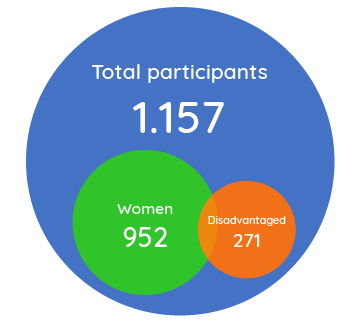
Beyond practical experience, young people participating in these programmes reported strong improvements in their readiness for employment. Across all projects, 1,157 participants indicated enhanced employability following their engagement in training, mentoring, or internships, reflecting the effectiveness of EU4Youth interventions in building work-relevant skills.
College of Europe Natolin Scholarship
Complementing hands‑on training, mentoring and internship pathways, EU4Youth also invests in advanced academic opportunities that support longer‑term leadership and career development.
Since 2021, the EU4Youth: Youth Employment and Entrepreneurship project has been providing annual scholarships enabling students from the Eastern Partnership countries to study at the College of Europe. The programme aims to deepen scholars’ understanding of European governance while fostering intercultural dialogue and mutual learning.
Throughout the ten-month European Interdisciplinary Studies programme at the Natolin campus in Poland, participants follow a rigorous academic curriculum complemented by professional development activities and language training. By the end of their studies, graduates are equipped with both the analytical knowledge and the leadership capabilities needed to act as constructive agents of change in their home countries.
In 2025, 12 participants supported under EU4Youth scholarship and fellowship schemes took part in inter‑ and intra‑regional mobility activities in addition to their formal studies or fellowship programmes. These mobility components included study visits to European institutions, participation in cross‑country policy dialogue, and exposure to multicultural learning environments. Of these participants, nine were women, and all were identified by the programme as disadvantaged youth, highlighting EU4Youth’s continued commitment to widening access to international learning opportunities for those facing structural barriers.
The Natolin Fellowship’s impact is illustrated by alumna Salome Kandelaki, whose research on church-state dynamics and EU integration demonstrates how the scholarship combines academic rigour with policy immersion. During her fellowship, she accessed first‑rate resources, engaged directly with EU experts, and completed a visiting fellowship at CEPS in Brussels – experience that strengthened her ability to connect complex, values‑laden debates (religion, pluralism, rights) to real‑world policy on enlargement and democratic resilience. This blend of study and practice is precisely what enables fellows to return home as credible, networked changemakers.
The students’ academic work continued to reflect the pressing priorities of their countries, ranging from information resilience and national security analysis to EU accession dynamics and regional cooperation, demonstrating the critical role of mobility schemes in shaping informed, future-oriented young leaders.
Community-based support
 At the community level, youth organisations and civil society partners played a targeted role in supporting young people to translate ideas into concrete actions, particularly in local and crisis‑affected contexts. Through outreach, mentoring and small‑scale, locally driven initiatives, these actors supported young people facing personal and socioeconomic barriers to participation and employment. While limited in geographic scope, these interventions contributed to improved individual employability outcomes and encouraged more inclusive forms of engagement, demonstrating the potential of community‑based support in enabling youth‑led action.
Together, these examples illustrate how locally anchored initiatives can help young people move from initial ideas to tangible outcomes when supported by responsive institutions and community partners, while complementing broader, programme‑level interventions described elsewhere in the report.
Working with veterans
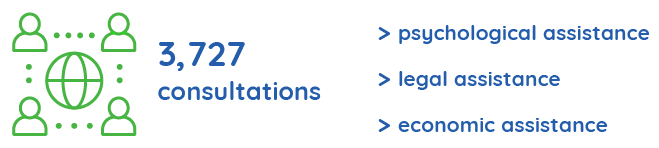
EU4Youth’s support proved essential for young veterans rebuilding their lives after service and injury. At the Checkpoint Rehabilitation Space in Zaporizhzhia, veterans accessed 3,727 consultations, including psychological, legal and economic assistance.
Denys, a platoon sergeant wounded near Avdiivka, described how the centre helped him emerge from months of isolation and mental decline

“I recommend everyone not to be afraid. Go, meet the specialists at the Rehabilitation Space. They’re wonderful and can help you with anything – whether it’s starting a business, solving a legal issue, or receiving counselling from psychologists. You must give it a try, because staying home alone really can drive you mad.”
Another veteran, Denys Bodnar, used an EU4Youth grant to convert part of his home into a private inclusive kindergarten, addressing a severe shortage of early childhood education in the Dnipropetrovsk region. As project lead Oleksandra Shchukina emphasised, “Each of these projects is not only a personal success for its founder but a contribution to the recovery and strengthening of Ukraine.”
Strengthening Psychosocial Support in Education During Conflict
The war has also placed significant emotional strain on children in Ukraine. To help address these needs, EU4Youth trained 430 educators and psychologists in trauma-informed methods, equipping them to provide emergency psychological support and create safer, more supportive learning environments. Through the Post Conflict Education and Trauma-informed Pedagogy Programme, young professionals gained urgently needed tools to support students during crisis situations.
Olena, a clinical psychologist from Kyiv, explained how the training transformed her ability to respond when children freeze in fear during sirens or explosions:
“These events have shaped the most important skill in me – to react quickly, be clear, and act to the point… I felt I was gaining knowledge I could apply not ‘someday’ but literally tomorrow.”